Bulgaria

Animal feed
Animal health and welfare
Biological hazards and zoonoses
Biotechnology and genetic engineering
Contaminants
Drinking water
Emerging risks
Environmental risk assessment (ERA)
Food contact materials and packaging
Food ingredients
Food supplements
Mineral water
Nanotechnology
Novel foods
Nutrition
Plant health
Plant protection products or pesticides
Residues of veterinary medicinal products
Reset filter

Last updated on 2024-01-09

National food safety structure

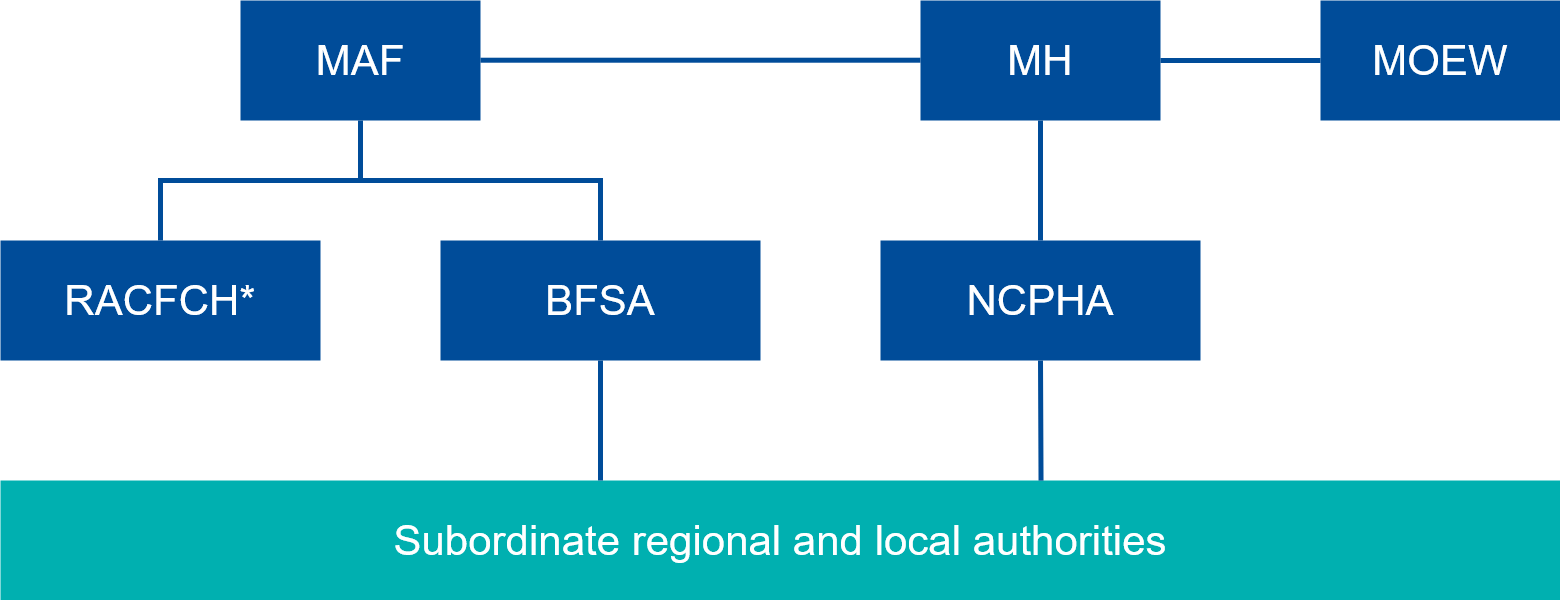
Simplified depiction of food safety authorities | © worldfoodsafetyalmanac.bfr.Berlin

* Host institution of the national EFSA Focal Point. For information on the EFSA Focal Point network, please see the EFSA website.

Legal foundation

The state policy in the field of food safety in Bulgaria is implemented by the Minister of Agriculture and Food, the Minister of Health, and the Minister of Economy and Industry, in accordance with the powers granted to them by law. The central legal foundations of food legislation in Bulgaria are the Food Act and the Agri-Food Chain Management Act.

The Food Act regulates the requirements related to food safety, the obligations of food business operators and individuals working in facilities for the production, processing, and/or distribution of food, the requirements for packaging, labeling, presentation, and advertising of food, the conditions for wholesale and retail trade of materials and articles intended to come into contact with food, the requirements for food transportation and distance selling, the standards for natural mineral, spring, and table waters, the provisions for foods intended for infants and young children, foods for special medical purposes, and foods enriched with vitamins, minerals, and other substances, the regulations on additives, enzymes, flavorings, and food supplements, the requirements for foods intended for consumption during intense muscular effort, the rules governing genetically modified foods and foods treated with ionizing radiation, the standards for smoke flavorings used in or on food, the provisions for novel foods, the conditions and procedures for food banking, the authorities responsible for official control during food production, processing, and/or distribution, and the conditions and procedures for food export. The provisions of the Food Act do not apply to the primary production of food for personal household consumption, the domestic preparation and storage of food intended for personal household use, and the production, processing, labeling, and trade of wine, wine products, grape-derived products, fruit wines, vinegar, ethyl alcohol and agricultural distillates, and spirits. The Food Act aims to ensure a high level of protection of consumer health and interests regarding food and to facilitate the implementation of European Union law and national measures in the food sector.

The Agri-Food Chain Management Act covers the authorities responsible for implementing state policy, official controls, and other official activities across the agri-food chain, the bodies conducting risk assessment and risk communication, the general requirements for conducting official controls and other official activities within the territory of the Republic of Bulgaria, the specific requirements for conducting official controls and other official activities related to food within the territory of the Republic of Bulgaria, the coordination and interaction of official control authorities with other institutions, the provision of administrative assistance and cooperation in the agri-food chain between the competent authorities of the Republic of Bulgaria, other Member States, the European Commission, and other EU institutions, the use of the Information Management System for Official Controls (IMSOC) within Bulgaria, the measures for crisis and emergency management in the agri-food chain, and the financing of activities related to official controls and other official functions. The Agri-Food Chain Management Act also sets out the conditions and procedures for the development and implementation of the Multiannual National Control Plan (MANCP), the sampling procedures, and the designation of laboratories for official control purposes and national reference laboratories.

Institutional separation of risk assessment and risk management has been in place in Bulgaria, since 2016.

In January 2011, the Bulgarian Parliament, following a political decision, established a new public authority by adopting the Law on the Bulgarian Food Safety Agency (BFSA). BFSA, within the Ministry of Agriculture and Food (MAF), is responsible for the official control on safety of food and feed throughout the food chain. Together with the agency, a Risk Assessment Center was created.

Initially the Risk Assessment Center (RAC) was established in 2011 and functioned within BFSA structure until 2016. Since 01 October 2016, the Law on Risk Assessment Center on Food Chain (RACFCH) was adopted and the Center was separated from the BFSA as an independent legal entity under MAF. RACFCH is the main authority in Bulgaria engaged in risk assessment and risk communication related to the food chain. Its risk assessments and scientific opinions are publicly available on the RACFCH website unless there are statutory provisions that prohibit it, and serve as a scientific ground for decision making process by the risk managers and policy makers.

 

Last updated on 2025-08-11

MAF

Ministry of Agriculture and Food

 https://www.mzh.government.bg/en/    Sofia

Activities
  • Risk communication
  • Risk management
  • Codex contact point
  • RASFF contact point
  • EFSA CEN representative
Topics

Within the Ministry of Agriculture and Food (MAF), the Agro-Food Chain Policy Directorate is responsible for the development, coordination and implementation of the state policy in the fields of quality and safety of food and feed, animal health, plant health and plant reproductive material, and border control on food chain safety. The Directorate is responsible for preparations and is involved in the development and coordination of draft legislative acts in the respective fields, coordination of control authorities within the Ministry, and in the coordination and preparation of a single multiannual national control plan in implementation of Regulation (EU) 2017/625. It also coordinates activities of the Ministry with the Ministry of Health, other agencies and branch organisations in the context of the quality and safety of food and feed, animal health, plant health and plant reproductive material, and border control along the food chain, and also coordinates activities between the Ministry and Bulgarian Food Safety Agency (BFSA). The Agro-Food Chain Policy Directorate is also responsible for market authorisation of genetically modified organisms (GMOs). It also serves as the national contact point in the Republic of Bulgaria for the following systems of the European Commission: Rapid Alert System for Food and Feed (RASFF), Administrative Assistance and Cooperation System (AAC), Food Fraud Network (FFN), Plant Health Network (PHN,), Pet Animals Network (PAN), Animal Welfare Network (AWN), and maintains their functioning.

Last updated on 2025-08-18

MH

Ministry of Health

 http://www.mh.government.bg/en/  Sofia

Activities
  • Risk communication
  • Risk management
Topics

The Ministry of Health (MH) is responsible for health policy and safety of bottled natural mineral, spring and table water (Directive 2009/54/EC) and the investigation of foodborne outbreaks in humans. In the area of food safety, MH is involved in drafting EU horizontal legislation and is responsible for the harmonisation of that legislation into national provisions.  The national centres of public health (National Center of Public Health and Analyses, National Center of Radiobiology and Radiation Protection and National Centre of Infectious and Parazitic Diseases) under MH conduct risk assessment on issues related to human health.

The portfolio of MH encompasses food chain management activities in the field of foods with added vitamins, minerals and other substances, infant formulae and follow-on formulae produced from protein hydrolysates and foods for special medical purposes within the scope of their competences.

Last updated on 2025-08-18

MOEW

Ministry of Environment and Water

 https://www.moew.government.bg/en/  Sofia

Activities
  • Risk communication
  • Risk management
Topics

The Ministry of Environment and Water develops and implements the state environmental policy, water management being one of the implemented sector policies. The state policy on water management aims to achieve and maintain good status of all groundwaters, surface waters and marine waters, as a vital resource for life on the planet, limiting the harmful effects on human life and health, environment, cultural heritage and business. 

Water management policy is focused, among others, on the provision of water of sufficient quantity and quality for the needs of the population, economy and ecosystems – continuity of water supply and reduction of the quantity of water withdrawn and used for consumption efficiency and management of water as an economic resource, as well as the financing of sustainable investments in water infrastructure.

At national level, water management policy is carried out by the Ministry, assisted by the Water Management Directorate, and at basin level – by 4 Basin Directorates. 15 Regional Inspectorates of Environment and Water monitor and control waste waters within their respective territorial scope.

Last updated on 2025-08-18

BFSA

Bulgarian Food Safety Agency

 https://bfsa.egov.bg/wps/portal/bfsa-web/home   Sofia

Activities
  • Risk communication
  • Risk management
Topics

The Bulgarian Food Safety Agency (BFSA) is a specialised body under MAF that is responsible for the official controls of safety of food and feed throughout the whole food chain, including control of food safety and quality, food additives and beverages, animal health and welfare, plant protection and fertilizers, phytosanitary control, feed, border control. BFSA is established in 2011 and incorporates the former National Veterinary Service, the former National Plant Protection Service, and the former National Grain and Feed Service, as well as the regional food health inspectors, who were responsible for the control of food of non-animal origin in the Regional Health Inspectorates (former Regional Inspectorates for Public Health Protection and Control) under MH and the quality compliance of fresh fruits and vegetables (under MAF).

BFSA is the competent government authority responsible for official controls in Bulgaria with respect to phytosanitary issues, plant protection products and fertilisers, veterinary activities, animal health and welfare, animal by-products not intended for human consumption, feedstuff, raw materials and foodstuff, materials and articles intended for contact with food, and the quality compliance of fresh fruits and vegetables with the European Commission standards for placing on the market. with the exception of bottled natural mineral, spring and table water. The central level of BFSA comprises 9 specialized departments/directorates, which are aligned with the above-mentioned activities.

The agency’s central office is in Sofia. It also has 28 regional food safety directorates distributed across the country as well as five specialised structures: the National Diagnostic and Research Veterinary Institute, the Central Laboratory for Veterinary Control and Ecology, the Central Laboratory for Chemical Testing and Control, the Central Laboratory for Plant Quarantine, and the Central Laboratory for Qualification of Grain and Feed. There are also 9 accredited laboratories at regional level intended to analyze some of the samples taken by the OC.

Last updated on 2025-08-18

RACFCH

Risk Assessment Center on Food Chain

 http://corhv.government.bg/?lang=_en  https://focalpointbg.com/   Sofia

Activities
  • Risk assessment
  • Risk communication
  • EFSA Focal Point
  • EFSA Advisory Forum
  • EFSA Management Board
Topics

The Risk Assessment Center on Food Chain (RACFCH) was established by the adoption of the Law on RACFCH and its Code of Organisation in 2016. It is managed by a director and assisted by a Management Board (on which MAF and MH are represented). RACFCH is an independent legal entity within the structure of MAF, a second level budget unit to the Minister of Agriculture and Food. RACFCH provides independent scientific risk assessments related to food safety, human health, animal health and welfare, food and feed additives, GMOs, dietetic products, nutrition and allergens, food contact materials and articles intended for contact with food, enzymes, flavourings and processing aids, biological hazards, contaminants, plant health and plant protection. RACFCH carries out activities for the approval, renewal, and review of approval of active substances, safeners and synergists under the terms and conditions of Regulation (EC) № 1107/2009 of the European Parliament and of the Council concerning the placing of plant protection products on the market. RACFCH works in close collaboration with EFSA and other national and international scientific institutions in the food and feed risk assessment area. The EFSA Management Board representative, the EFSA Advisory Forum representative and the national EFSA Focal Point are located within RACFCH.

Last updated on 2025-08-18

NCPHA

National Center of Public Health and Analysis

 https://ncpha.government.bg/   Sofia

Activities
  • Risk assessment
  • Risk communication
Topics

The National Center of Public Health and Analyses (NCPHA) is a structure of the national health care system and carries out activities on: Protection of public health, Health promotion and disease prevention, Information provision of healthcare management. The mission of the National Center of Public Health and Analyses is to combine these diverse activities in the interest of better public health.

NCPHA is subordinate to MH and is responsible for epidemiological data on the dietary intake and nutritional status of the Bulgarian population and takes part in the development and implementation of European and national legislation in GMOs, food contact materials, food supplements, food additives, bottled waters, novel foods, foods for special medical purposes, infant formula and follow-on formula, addition of vitamins and minerals and of certain other substances to foods.

Regional and local levels

Bulgaria consists of 28 administrative regions with 264 municipalities. Inspections at regional and local levels are conducted by authorities that are subordinate to the central government (headquarters). Both MH and MAF have 28 regional services which report their activities to the central level in the ministries.