Montenegro

Animal feed
Animal health and welfare
Biological hazards and zoonoses
Biotechnology and genetic engineering
Contaminants
Drinking water
Emerging risks
Environmental risk assessment (ERA)
Food contact materials and packaging
Food ingredients
Food supplements
Mineral water
Nanotechnology
Novel foods
Nutrition
Plant health
Plant protection products or pesticides
Residues of veterinary medicinal products
Reset filter

Last updated on 2026-06-29

National food safety structure

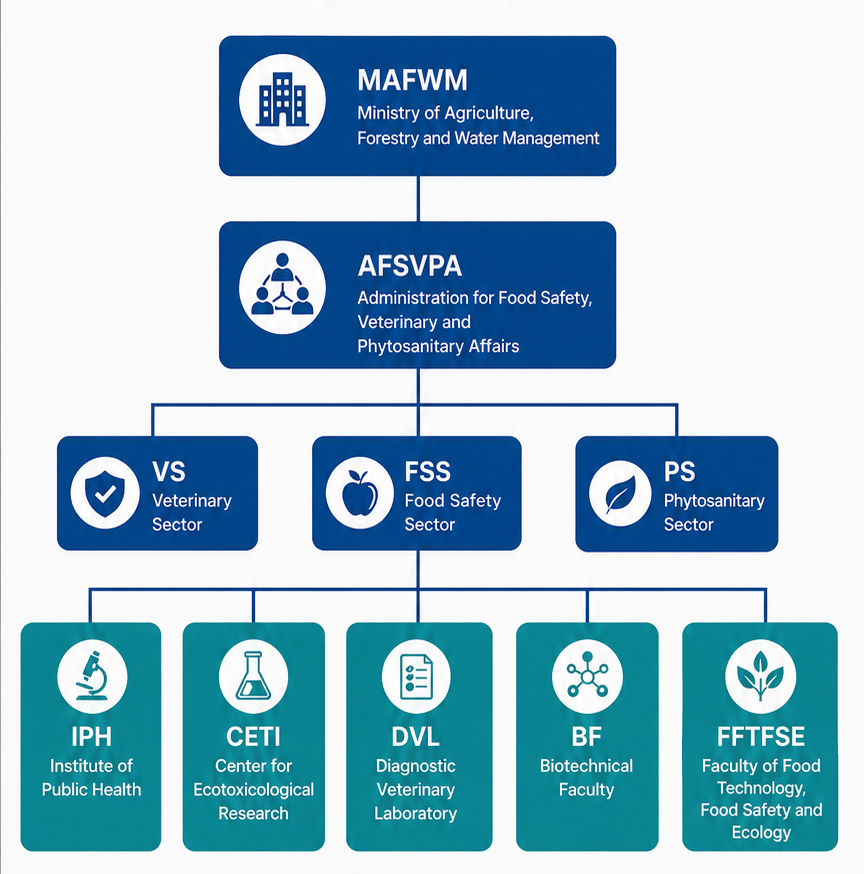
Simplified depiction of food safety authorities | © worldfoodsafetyalmanac.bfr.Berlin

* Host institution of the national EFSA Focal Point. For information on the EFSA Focal Point network, please see the EFSA website.

Legal foundation

The Law on Food Safety (Official Gazette of Montenegro No. 59/2026) is the umbrella legislation governing food and feed safety in Montenegro. It lays down the general principles and requirements of food and feed law, defines the responsibilities of food and feed business operators, establishes the legal framework for risk analysis, official controls and crisis management, and provides the basis for the adoption of implementing legislation, including regulations and rulebooks governing specific areas of food and feed safety.

In addition to the Law on Food Safety, several sector-specific laws regulate particular areas falling within the competence of the Administration for Food Safety, Veterinary and Phytosanitary Affairs. These include the Law on Official Controls (Official Gazette of Montenegro No. 72/2026), which establishes a harmonised framework for official controls and other official activities performed throughout the agri-food chain in accordance with the risk-based approach; the Law on Animal Health (Official Gazette of Montenegro No. 79/2026), which regulates the prevention, surveillance and control of animal diseases, animal health measures and responsibilities of competent authorities and operators, and which entered into force on 17 June 2026 and shall apply from 1 January 2027; the Law on Plant Health (Official Gazette of Montenegro No. 39/2026), which regulates measures for the prevention of the introduction, establishment and spread of plant pests and establishes the phytosanitary protection system; and the Law on Plant Protection Products (Official Gazette of Montenegro No. 59/2026), which governs the authorisation, placing on the market, sustainable use and official control of plant protection products.

Competent authorities for state administration activities in the areas of food safety, veterinary and phytosanitary policy are the state administration authority responsible for agriculture, food safety and veterinary affairs (the Ministry of Agriculture, Forestry and Water Management – MAFWM) and the Administration for Food Safety, Veterinary and Phytosanitary Affairs (AFSVPA), which performs administrative, inspection and official control activities within its competences.

Risk assessment is based on the available scientific evidence and is carried out independently, objectively and transparently. Risk assessments may be performed by scientific institutions authorised by the MAFWM that meet the prescribed professional requirements. Where no such institution exists in Montenegro, the Ministry may authorise a competent scientific institution from a Member State of the European Union to perform the assessment.

Risk management is carried out by the AFSVPA through risk-based official controls, surveillance, monitoring programmes and preventive measures aimed at preventing, reducing or eliminating risks to human and animal health. In performing risk management activities, the AFSVPA takes into account scientific risk assessments and opinions prepared by authorised scientific institutions, the European Food Safety Authority (EFSA), as well as other legitimate factors relevant to the protection of public health and consumer interests.

Where food or feed may pose a risk to human or animal health, the competent authorities shall ensure timely communication with the public by providing information on the nature of the risk, the products concerned and the measures adopted to prevent, reduce or eliminate the identified risk.

MAFWM

Ministry of Agriculture, Forestry and Water Management

Ministarstvo poljoprivrede, šumarstva i vodoprivrede

 https://www.gov.me/en/mpsv  Podgorica

Activities
  • Agricultural and rural development policy
  • Food and feed safety
  • Food and feed safety policy
Topics

The Ministry of Agriculture, Forestry and Water Management (MAFWM) is the competent authority responsible for developing and implementing national policies in the fields of agriculture, rural development, food safety, veterinary and phytosanitary affairs, forestry, fisheries, aquaculture, water management and hunting. The Ministry prepares and proposes primary and secondary legislation, develops strategic and policy documents, coordinates the harmonisation of national legislation with the European Union acquis, performs administrative and inspection supervision, and coordinates international cooperation within its areas of competence.

In the field of food and feed safety, the Ministry is responsible for establishing the national legislative and policy framework and ensuring its continuous alignment with European Union legislation. It prepares and proposes legislation governing food safety, official controls, animal health, plant health, plant protection products and other related areas, develops national strategies and policy documents, coordinates activities related to Montenegro's EU accession process under Chapter 12 – Food Safety, Veterinary and Phytosanitary Policy, and cooperates with the European Commission and other international organisations within its areas of competence. The Ministry performs other tasks in accordance with the applicable legislation.

Last updated on 2026-06-29

AFSVPA

Administration for Food Safety, Veterinary and Phytosanitary Affairs

Uprava za bezbjednost hrane, veterinu i fitosanitarne poslove - UBHVFP

 https://www.gov.me/ubh  Podgorica

Activities
  • EFSA Focal Point
  • Food safety
  • Veterinary and phytosanitary policy
  • WOAH delegate
  • EFSA Advisory Forum
Topics

The Administration for Food Safety, Veterinary and Phytosanitary Affairs (AFSVPA) is the competent authority responsible for implementing legislation and carrying out official controls in the areas of food and feed safety, veterinary and phytosanitary affairs. It operates under the supervision of the Ministry of Agriculture, Forestry and Water Management (MAFWM) and performs administrative, regulatory, inspection and expert tasks within its fields of competence.

The AFSVPA is organised into three operational departments:

  • Food Safety Department (FSD) – responsible for food and feed safety, registration and approval of food and feed business operators, implementation of monitoring programmes, risk management activities and enforcement of food safety legislation. The Department includes the Food Inspection, which carries out official controls in food and feed establishments, on the domestic market and at designated Border Control Posts (BCPs) for food of non-animal origin, food of animal origin, and feed.
  • Veterinary Department (VD) – responsible for animal health, animal welfare, veterinary public health, veterinary medicinal products, identification and registration of animals, products of animal origin, animal by-products, disease surveillance and eradication programmes, and veterinary legislation. The Department includes the Veterinary Inspection, which performs official controls throughout the territory of Montenegro and at designated Border Control Posts (BCPs) for live animals, products of animal origin and other commodities subject to veterinary controls.
  • Phytosanitary Department (PD) – responsible for plant health, plant protection products, fertilising products, plant reproductive material, plant variety protection, plant genetic resources and genetically modified organisms within its competence. The Department includes the Phytosanitary Inspection, which carries out official controls throughout the territory of Montenegro and at designated Border Control Posts (BCPs) for plants, plant products and other regulated articles.

The AFSVPA prepares and implements the Multi-Annual National Control Plan (MANCP), develops annual official control and monitoring programmes, prepares contingency plans, maintains national registers of approved and registered food and feed business operators, grants approvals and registrations for establishments operating in the food and feed chain, and coordinates official controls throughout the agri-food chain in accordance with the applicable legislation.

The Administration is the national competent authority for cooperation with the European Food Safety Authority (EFSA) through the EFSA Focal Point, facilitating scientific cooperation, the exchange of information, networking and capacity-building activities between Montenegro and EFSA. It also cooperates with the European Commission, the World Organisation for Animal Health (WOAH), the Food and Agriculture Organization of the United Nations (FAO), the European and Mediterranean Plant Protection Organization (EPPO) and other international organisations and competent authorities within its fields of competence.

The Director of the AFSVPA performs the function of Chief Veterinary Officer (CVO) of Montenegro and serves as Montenegro's Official Delegate to the World Organisation for Animal Health (WOAH).

Laboratory analyses of samples taken during official controls and monitoring programmes are performed by official laboratories authorised by the Ministry of Agriculture, Forestry and Water Management. Laboratories designated for official testing are required to comply with the relevant accreditation requirements, including ISO/IEC 17025. Where no suitable national laboratory exists, a reference laboratory from a Member State of the European Union or the European Free Trade Association (EFTA) may be designated in accordance with the applicable legislation.

Further institutions

Laboratories and Academic Institutions

Montenegro has three public laboratories that provide analytical support to the national food safety, veterinary and phytosanitary control system: the Institute of Public Health (IPH), the Centre for Ecotoxicological Research (CETI) and the Diagnostic Veterinary Laboratory (DVL). These laboratories perform official analyses within their respective fields of competence and support risk assessment, official controls and monitoring programmes implemented by the competent authorities.

The Institute of Public Health (IPH) performs microbiological, parasitological, chemical, biological, toxicological, biochemical and other laboratory analyses of food, food contact materials, drinking water, surface water and wastewater, thereby contributing to the protection of public health.

The Centre for Ecotoxicological Research (CETI) has been authorised since 1998 to perform official analyses related to food safety and products intended for general use, while since 1999 it has also been authorised to analyse agricultural and food products in international trade. CETI carries out a wide range of accredited analyses, including pesticide residue testing, contaminant analysis and other physico-chemical examinations relevant to food and environmental safety.

The Diagnostic Veterinary Laboratory (DVL) is the national reference laboratory for veterinary diagnostics and performs accredited laboratory testing in the fields of animal health and food of animal origin. Its accredited scope includes microbiological analyses of meat, meat products, milk and dairy products, eggs and egg products, as well as parasitological examinations and a broad range of diagnostic methods supporting animal disease surveillance, official controls and national monitoring programmes.

To further strengthen laboratory capacities in the phytosanitary sector, Montenegro is currently constructing a National Phytosanitary Laboratory, which will significantly enhance national capabilities for the diagnosis of plant pests, laboratory support for official controls and implementation of plant health legislation. Completion of the laboratory is planned by the end of 2026.

The Biotechnical Faculty (BTF) of the University of Montenegro is the leading higher education and scientific institution in the field of agriculture. The Faculty carries out research in agriculture, plant protection, animal production and related disciplines, while continuously strengthening scientific capacities through participation in international research projects and cooperation with European institutions. It also provides scientific support for plant health programmes and other activities relevant to the competent authorities.

The Faculty of Food Technology, Food Safety and Ecology (FFTFSE), established in 2012, provides undergraduate and postgraduate education in food technology, food safety, sanitary engineering, HoReCa systems and environmental engineering. The Faculty conducts scientific research in food science, nutrition, biotechnology and environmental protection, with particular emphasis on interdisciplinary research and innovation in food safety and sustainable food systems.

Food safety, veterinary and phytosanitary inspections are organised within the Administration for Food Safety, Veterinary and Phytosanitary Affairs (AFSVPA) and are responsible for implementing official controls throughout the agri-food chain in accordance with risk-based principles.

Official controls under the Law on Food Safety are carried out by food inspectors, official veterinarians, veterinary inspectors, phytosanitary inspectors and border inspectors within their respective fields of competence.

Veterinary inspectors perform official controls related to animal health and welfare, the movement and trade of live animals, products of animal origin, animal by-products, quarantine facilities and establishments, as well as checks at places of dispatch and destination of consignments.

Border controls on animals, products of animal origin and other commodities subject to veterinary requirements are currently performed at 10 Border Control Posts (BCPs), comprising eight land border crossings, one at the Port of Bar and one at Podgorica Airport.

Food inspectors are responsible for official controls of food and feed placed on the market, while veterinary and phytosanitary border inspectors perform official controls on consignments entering Montenegro through designated Border Control Posts.

Phytosanitary inspectors are responsible for implementing official controls in the field of plant health, plant protection products, plant reproductive material and other phytosanitary requirements, ensuring compliance with national legislation and the relevant European Union acquis.