
Italy

Animal feed
Animal health and welfare
Biological hazards and zoonoses
Biotechnology and genetic engineering
Contaminants
Drinking water
Emerging risks
Environmental risk assessment (ERA)
Food contact materials and packaging
Food ingredients
Food supplements
Mineral water
Nanotechnology
Novel foods
Nutrition
Plant health
Plant protection products or pesticides
Residues of veterinary medicinal products
Reset filter

Last updated on 2025-11-03

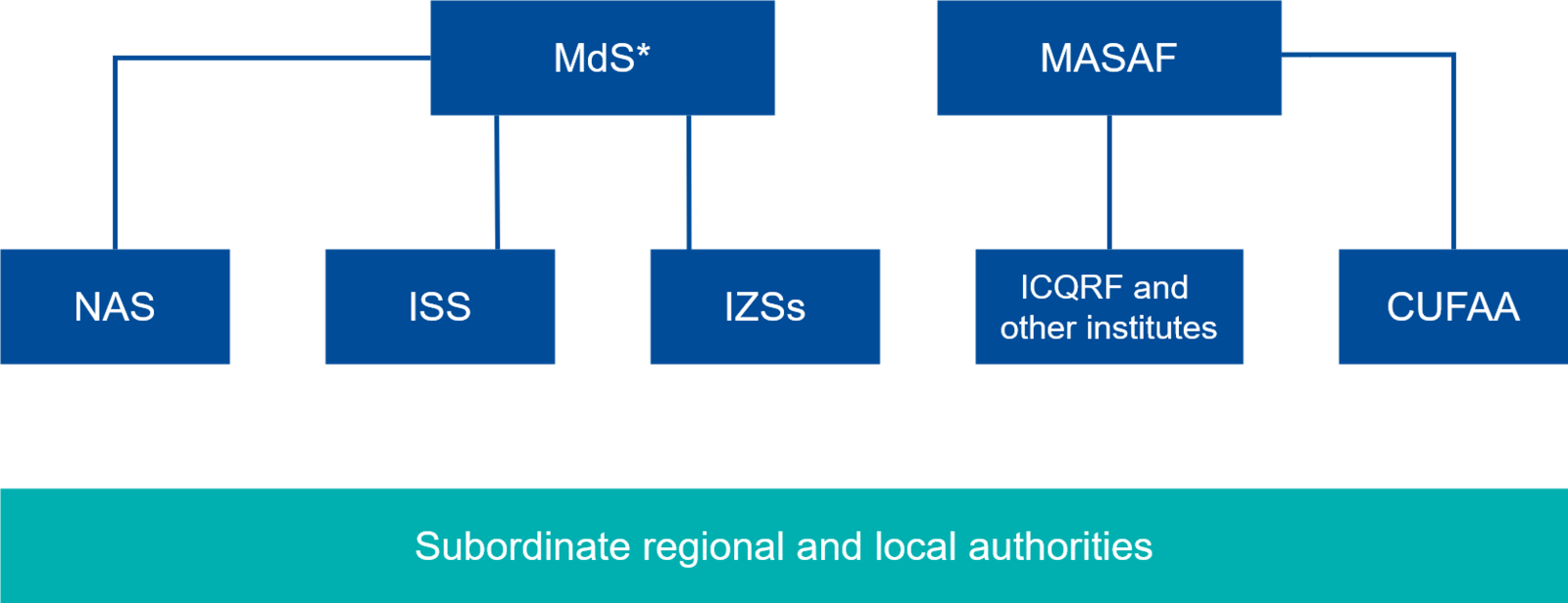
National food safety structure

Simplified depiction of food safety authorities | © worldfoodsafetyalmanac.bfr.Berlin

* Host institution of the national EFSA Focal Point. For information on the EFSA Focal Point network, please see the EFSA website.

Legal foundation

Regulation (EC) No. 178/2002 of the European Parliament and of the Council of 28 January 2002 laying down the general principles and requirements of food law is the central legal foundation for food legislation in Italy. Infringement of food regulations can lead to measures under criminal law and consumer damage claims under civil law, whereby the final decision rests with the courts.

Government measures concerning food safety are based on scientific evidence and, more particularly, on scientific risk assessments.

In Italy, risk assessment and risk management are institutionally separated. Risk assessments are usually published on the Internet.

MdS

Ministry of Health

Ministero della Salute

 http://www.salute.gov.it  Rome

Activities
  • Risk assessment
  • Risk communication
  • Risk management
  • EFSA Focal Point
  • RASFF contact point
  • Health policy, food safety
Topics

In Italy, most of the mandates for food and feed safety, animal health and animal welfare are assigned at the national level to the Ministry of Health (MdS), recently reorganised by the Decree of the President of the Council of Ministers No. 196 of 30 October 2023. In particular, the aforementioned responsibilities fall under the remit of the Department for Human Heath, Animal Health and the Ecosystem (One Health) and International Relations (DOHRI), with its Directorates-General:

  • Directorate-General for Animal Health (DGSA)
  • Directorate-General for Food Hygiene and Safety (DGISAN)
  • Directorate-General for Healthy Lifestyles and Relations with the Ecosystem (DGCSV)

As regards risk assessment, the Department for Human Heath, Animal Health and the Ecosystem (One Health) and International Relations (DOHRI) is the national reference authority for the European Food Safety Authority (EFSA), with the support of the Directorate-General for Healthy Lifestyles and Relations with the Ecosystem (DGCSV). In particular, the DGCSV performs the functions of EFSA Focal Point and support to the EFSA Advisory Forum through its Office 3.

In addition, the DGCSV is responsible for coordinating risk assessment processes and implementing risk assessments for physical, chemical and biological hazards for food safety purposes, as well as for consulting with consumer and producer associations. All activities related to risk assessments and consultations with associations are carried out with the support of the two specific sections of the National Committee for Food Safety (CNSA). In particular, the Food Safety Section provides scientific advice at the request of the central Competent Authorities as well as the Competent Authorities of the regions and autonomous provinces.

The DGSA and the DGISAN perform the funcions assigned to the DOHRI with regard to risk management in the fields of food and feed safety, animal health and animal welfare, both domestically and at the import stage.

In view of the division of competencies provided for by national legislation, official controls on the territory are planned and carried out by the regional and local Competent Authorities on the basis of guidelines issued by the Ministry.

The remit of the MdS includes official controls during import of food and feed, general food and feed hygiene, novel food, food supplements, labelling and nutrition, food contact materials, genetically modified organisms (GMOs), zoonoses, residues of plant protection products, and veterinary medicinal products. In addition, the MdS is the regulatory authorithy for plant protection products and veterinary medicinal products, and may conduct inspections and audits of the regional Competent Authorities.

Italy introduced administrative sanctions against violations of Regulation (EC) No. 178/2002 by Legislative Decree No. 190/2006, and implemented the EU Hygiene Package by Legislative Decree No. 193/2007 (amended by Legislative Decree No. 27/2021), which identifies the national Competent Authorities for official controls. In cases where an identified nonconformity may pose a risk to public health, criminal charges may also be brought.

All control activities in the field of food safety are integrated in a Multi-Annual National Control Plan (MANCP) developed in compliance with Title V of Regulation (EC) No. 2017/625.

MASAF

Ministry of Agriculture, Food Sovereignty and Forestry

Ministero dell'Agricoltura, della Sovranità alimentare e delle Foreste

 http://www.politicheagricole.gov.it  Rome

Activities
  • Risk communication
  • Risk management
  • Codex contact point
  • Agricultural policy
  • Controls on quality, labelling and traceability of food and feed
  • Some aspects in the field of plant protection products and fertilisers
Topics

Within the Ministry of Agriculture, Food Sovereignty and Forestry (MASAF), the Department of Food Sovereignty and Horse Racing (DISAI), with its Directorate-General for the Promotion of Agri-Food Quality (PQA), is responsible for the coordination of activities related to the quality of agricultural products and food. 

The Department of Common Agricultural Policy and Rural Development (DIPACSR), with its Directorate-General for Rural Development (DISR), is responsible for plant health, seeds, propagation material, fertilisers and some aspects of the field of plant protection products, as well as for husbandry.

The Department of Central Inspectorate for Quality Controls and Antifraud of Foodstuff and Agricultural Products (ICQRF) is the law enforcement body of the MASAF responsible for fraud prevention. It carries out controls on labelling and quality of foodstuffs, agricultural product feed, fertilisers and plant protection products via its own laboratory network.

ISS

National Institute of Health

Istituto Superiore di Sanità

 https://www.iss.it  Rome

Activities
  • Risk assessment
Topics

At the national level, the National Institute of Health (ISS) is a technical and scientific public body of the Italian National Health Service and a public research institution supervides by the Ministry of Health. The ISS oversees the laboratories of the Italian National Health Service engaged in food and feed control and performs confirmatory analyses. Its activities include research, control, training and consultation in the interest of public health protection. One of the activities carried out by the institute consists in supporting inspections and quality controls of food products and packaging at the request of the Ministry of Health or the Regions.

IZSs

Experimental Zooprophylactic Institutes

Istituti Zooprofilattici Sperimentali

Activities
  • Risk assessment
Topics

The 10 Experimental Zooprophylactic Institutes (IZSs) are official laboratories operating at the local and national level as technical and scientific public sector bodies of the Italian National Health Service, under the supervsion of the Competent Authorities (Ministry of Health and Regions). One of the activities carried out by the IZSs consists in supporting inspections and quality controls of food products and packaging, at the request of the Ministry of Health or the Regions.

All the official laboratories, including those mentioned in the ‘Regional and local levels’ section, are accredited for specific activities by the National Accreditation Body (ACCREDIA), nominated by the government under Regulation (EC) No. 765/2008 and operating under the supervision of the Ministry of Enterprises and Made in Italy.

Regional and local levels

Except for the matters explicitly reserved to the central government, responsibility for controls in food safety and veterinary public health has been devolved to the regional level. The 19 Regions and 2 Autonomous Provinces, in their capacity of Regional Competent Authorities, have responsibility for planning, coordination, guidance, authorisation and verification within their territories. 

The operational implementation of controls is handled at the local level by around one hundred Local Health Units (ASLs), which are Local Competent Authorities and have a high degree of managerial autonomy. Local Health Units are responsible for local controls on animal health, animal welfare and food, both of animal and non-animal origin. The analyses are conducted by official laboratories: the network of Experimental Zooprophylactic Institutes (IZSs), the network of Regional and Provincial Agencies for Environment Protection (ARPAs and APPAs) and the network of Public Health Laboratories.

Further institutions

Article 36 Institutions (Institutions involved in the EFSA network pursuant to Article 36 Reg. (EC) No. 178/2002)

  1. Ministry of Health (Ministero della salute - MdS) (EFSA Focal Point)
  2. Italian National Institute of Health (Istituto Superiore di Sanita - ISS)
  3. Council for Agricultural Research and Economics (Consiglio per la ricerca in agricoltura e l'analisi dell'economia agraria - CREA)
  4. National Research Council (Consiglio Nazionale delle Ricerche - CNR)
  5. Italian National Agency for New Technologies, Energy and Sustainable Economic Development (Agenzia Nazionale per le nuove tecnologie, l'energia e lo sviluppo economico sostenibile - ENEA)
  6. Experimental Zooprophylactic Institute of Abruzzo and Molise (Istituto Zooprofilattico Sperimentale dell'Abruzzo e del Molise ‘G. Caporale’ - IZSAM)
  7. Experimental Zooprophylactic Institute of Apulia and Basilicata (Istituto Zooprofilattico Sperimentale della Puglia e della Basilicata - IZSPB)
  8. Experimental Zooprophylactic Institute of Lazio and Tuscany (Istituto Zooprofilattico Sperimentale delle Regioni Lazio e Toscana - IZSLT)
  9. Experimental Zooprophylactic Institute of Lombardy and Emilia-Romagna (Istituto Zooprofilattico Sperimentale della Lombardia e dell'Emilia-Romagna ‘Bruno Ubertini’, IZSLER)
  10. Experimental Zooprophylactic Institute of Piedmont, Liguria and Aosta Valley (Istituto Zooprofilattico Sperimentale del Piemonte, Liguria e Valle d'Aosta - IZSPLV)
  11. Experimental Zooprophylactic Institute of Sicily (Istituto Zooprofilattico Sperimentale della Sicilia ‘A.Mirri’ - IZS Sicilia)
  12. Experimental Zooprophylactic Institute of Umbria and Marche (Istituto Zooprofilattico Sperimentale dell'Umbria e delle Marche - IZSUM)
  13. Experimental Zooprophylactic Institute of Venezie (Istituto Zooprofilattico Sperimentale delle Venezie - IZSVe)
  14. University of Bologna ‘Alma Mater Studiorum’ (Università degli Studi di Bologna ‘Alma Mater Studiorum’ - UNIBO)
  15. Università Cattolica del Sacro Cuore (UNICATT)
  16. Azienda Socio Sanitaria Territoriale (ASST) Fatebenefratelli Sacco
  17. University of Eastern Piedmont (Università degli Studi del Piemonte Orientale ‘Amedeo Avogadro’ - UNIUPO)
  18. University of Bari ‘Aldo Moro’ (Università degli Studi di Bari ‘Aldo Moro’ - UNIBA)
  19. University of Foggia (Università degli Studi di Foggia - UNIFG)
  20. University of Milan (Università degli Studi di Milano - UNIMI)
  21. University of Palermo (Università degli Studi di Palermo - UNIPA)
  22. University of Parma (Università degli Studi di Parma - UNIPR)
  23. University of Pavia (Università degli Studi di Pavia - UNIPV)
  24. University of Perugia (Università degli Studi di Perugia - UNIPG)
  25. University of Rome ‘La Sapienza’ (Università degli Studi di Roma ‘La Sapienza’ - UNIROMA1)
  26. Experimental Zooprophylactic Institute of Mezzogiorno (Istituto Zooprofilattico Sperimentale del Mezzogiorno - IZSM)
  27. Italian Institute for Environmental Protection and Research (Istituto Superiore per la Protezione e la Ricerca Ambientale - ISPRA)
  28. University of Napoli ‘Federico II’ (Università degli Studi di Napoli ‘Federico II’ - UNINA)
  29. University of Modena and Reggio Emilia (Università degli Studi di Modena e Reggio Emilia - UNIMORE)
  30. Edmund Mach Foundation (Fondazione Edmund Mach - FEM)
  31. University of Turin (Università degli Studi di Torino - UNITO)
  32. University of Ferrara (Università degli Studi di Ferrara - UNIFE)
  33. University of Padova (Università degli Studi di Padova - UNIPD)
  34. University of Brescia (Università degli Studi di Brescia - UNIBS)
  35. Politecnico Milano (Politecnico di Milano - POLIMI)
  36. University of Catania (Università degli Studi di Catania - UNICT)
  37. Experimental Zooprophylactic Institute of Sardinia (Istituto Zooprofilattico Sperimentale della Sardegna - IZSSA)
  38. University of Pisa (Università degli Studi di Pisa - UNIPI)
  39. University of Milano-Bicocca (Università degli Studi di Milano-Bicocca - UNIMIB)
  40. University of Catanzaro ‘Magna Graecia’ (Università degli Studi 'Magna Graecia' di Catanzaro - UNICZ-UMG)
  41. Elettra Sincrotrone Trieste S.C.p.A (Elettra Sincrotone Trieste S.C.p.A. - Elettra)
  42. Laimburg Research Centre (Centro di Sperimentazione Laimburg - CSL)