
Belgium

Animal feed
Animal health and welfare
Biological hazards and zoonoses
Biotechnology and genetic engineering
Contaminants
Drinking water
Emerging risks
Environmental risk assessment (ERA)
Food contact materials and packaging
Food ingredients
Food supplements
Mineral water
Nanotechnology
Novel foods
Nutrition
Plant health
Plant protection products or pesticides
Residues of veterinary medicinal products
Reset filter

Last updated on 2026-07-14

National food safety structure

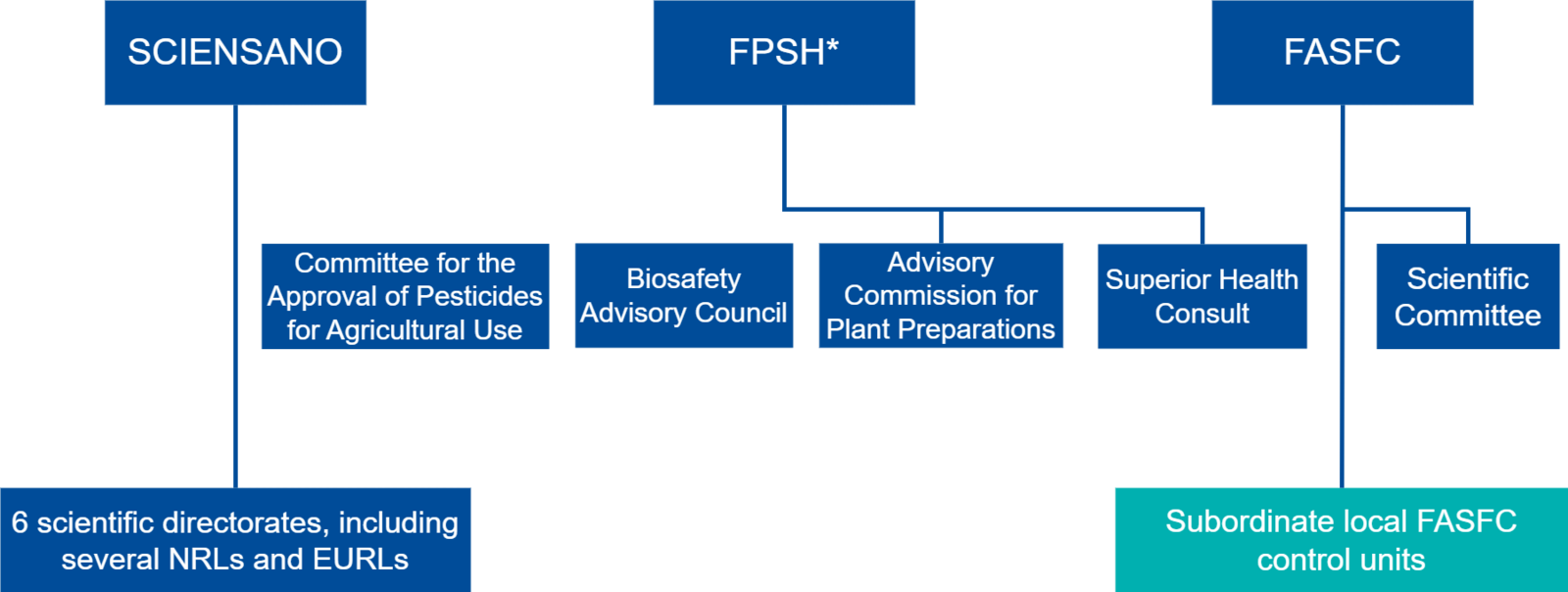
Simplified depiction of food safety authorities | © worldfoodsafetyalmanac.bfr.Berlin

* Host institution of the national EFSA Focal Point. For information on the EFSA Focal Point network, please see the EFSA website.

Legal foundation

Regulation (EC) No. 178/2002 and national food laws are the central legal foundation for food legislation in Belgium. Infringement of food regulations can lead to measures under criminal law and consumer damage claims under civil law, whereby the final decision rests with the courts. In Belgium, several independent organisations are involved in the risk assessment of food and feed safety. However, there is no strict institutional separation of risk assessment and risk management. Risk assessments are published on the Internet unless there are statutory provisions that prohibit it.

Last updated on 2026-06-17

FPSH

Federal Public Service for Health, Food Chain Safety and Environment

 https://www.health.belgium.be/en  Brussels

Activities
  • Risk assessment
  • Risk communication
  • Risk management
  • Codex contact point
  • EFSA Focal Point
  • EFSA Advisory Forum
  • WHO Food Safety and Nutrition Counterparts
  • OIE
  • EPPO
  • IPPC
  • ECHA Management Board
  • ECDC Management Board
Topics

The Federal Public Service for Health (FPSH) is the federal authority responsible for policy and legislation in the area of food and feed safety, including novel foods, food supplements, chemical and microbiological contaminants, additives, enzymes, flavourings, processing aids, allergens, labelling and claims, dietetic products and food for special groups, food contact materials, bottled water, water used by food business operators, zoonoses, plant protection products and their residues, fertilisers and genetically modified organisms (GMOs).

The regulatory authority for veterinary medicinal products is the Federal Agency for Medicines and Health Products (FAMHP), which is the competent authority responsible for the supervision of the quality, safety and efficacy of medicines for human and veterinary use (including homeopathic medicines, herbal medicines, pharmacy-made and official preparations), of medical devices and accessories as well as raw materials for the preparation and production of medicines.

The FPSH is responsible for defining policy, drafting legislation, and authorizing products prior to marketing in the area of food and feed safety. According to the General Food Law, the tasks of the FPSH are based on risk analyses. Risk assessments and scientific opinions are carried out by the FPSH, Sciensano or the Belgian Superior Health Council (BSHC), depending on the topics. The BSHC acts as a link between government and the scientific world in the field of nutrition and food safety.

The tasks and missions of the FPSH are also supported by stakeholder consultative platforms.

The FPSH follows an integrated and interconnected approach to health protection that is based on the “One Health” concept.

Other institutions provide the FPSH with scientific opinions on food safety: the Belgian Biosafety Advisory Council (BAC), the Advisory Commission for Plant Preparations and, in specific cases, the Scientific Committee established at the Federal Agency for the Safety of the Food Chain (FAFSC), as well as external academic departments.

The FPSH provides funding for scientific research in the area of food safety, animal health and plant health. There are yearly calls for project proposals, with both a bottom-up (“free research”) and top-down (“targeted research”) approach.

The areas of missions and tasks of the FPSH extend beyond food safety, including to nutrition policy, breastfeeding policy, animal health, plant health, the environment, cosmetics, biocides, REACH, antibiotic resistance, tobacco, alcohol, human health, and others. 

Last updated on 2026-07-14

FASFC

Federal Agency for the Safety of the Food Chain

 https://www.fasfc.be/  Brussels

Activities
  • Risk assessment
  • Risk communication
  • Risk management
  • RASFF contact point
  • Multi-annual national control plan
Topics

The Federal Agency for the Safety of the Food Chain (FASFC) is the federal executive agency responsible for official controls and inspections, related to operational risk assessments, as well as for the definition and enforcement of operational legislation related to official control of the food chain (from farm to fork). The agency carries out official controls of food, feed and its raw materials at all stages of the feed and food chain, including production, processing, storage, transport, trade, and import and export of food and its raw materials. The FASFC oversees all official controls on the basis of multi-annual national control plans. In addition, it is also responsible for the control of animal health and plant health.

To fulfil its tasks, the FASFC is supported by two committees. The Advisory Committee includes all FASFC stakeholders and provides consultative opinions on risk management matters. In connection with the FASFC competencies and control activities, the Scientific Committee provides independent consultative scientific opinions on risks affecting food chain safety, animal and plant health, related legal acts as well as each matter it is considering relevant in those fields.

Last updated on 2026-07-14

SCIENSANO

The Belgian Health Research Institute

 https://www.sciensano.be/en  Brussels

Activities
  • Risk assessment
  • Risk communication
  • Research
Topics

Sciensano is a public and independent scientific institute dedicated to human and animal health and their environment. They conduct scientific research and surveillance, and support the government and various agencies and organisations with health expertise, advice and services. Sciensano attaches great importance to the One Health principle, which emphasises that the health of humans, animals and their environment are interconnected. Therefore, our research is interdisciplinary and integrates different perspectives.

With more than a thousand employees and 120 years of scientific expertise, Sciensano is a renowned science institute, part of several international scientific networks.

In the context of EFSA’s remits, Sciensano focuses on food consumption and food safety, (human and animal) health and disease monitoring, and on the link between health and the environment (e.g. pesticides).

Using food consumption surveys, Sciensano analyses citizens’ nutritional habits. Sciensano also identify pathogens in food (and human infections caused by food pathogens) and keeps an eye on GMOs, food contaminants, residues (pesticides, heavy metals, etc.), food contact materials, additives and nanomaterials, for which Sciensano also assesses the risks. In terms of animal health, Sciensano is involved in a broad range of activities (e.g. epizootic diseases, emerging diseases that pose a major socioeconomic risk, but also diseases whose impact is solely economic, such as foot-and-mouth disease). Furthermore, Sciensano also addresses important transversal problems such as antimicrobial resistance and zoonoses.

Regional and local levels

The regional and local levels of the Belgian Federal State consist of three regions, 10 provinces and 589 districts. Local FASFC control units are responsible for conducting food inspections. The central FASFC unit is responsible for coordinating food inspections. The monitoring of drinking water is the responsibility of the regional authorities.

Further institutions

Article 36 Institutions (Institutions involved in the EFSA network pursuant to Article 36 Reg. (EC) No. 178/2002)

  1. Federal Public Service (FPS) Health, Food Chain Safety and Environment (EFSA Focal Point)
  2. Federal Agency for the Safety of the Food Chain (FASFC)
  3. Sciensano
  4. Walloon Agricultural Research Centre (CRA-W)
  5. Own Capital of the Institute for Agricultural and Fisheries Research
  6. Ghent University (Universiteit Ghent)
  7. Centre d'Economie Rurale (CER Group)
  8. University of Liege (Université de Liège)
  9. Catholic University of Louvain (Université Catholique de Louvain)
  10. Hasselt University (Universiteit Hasselt)